


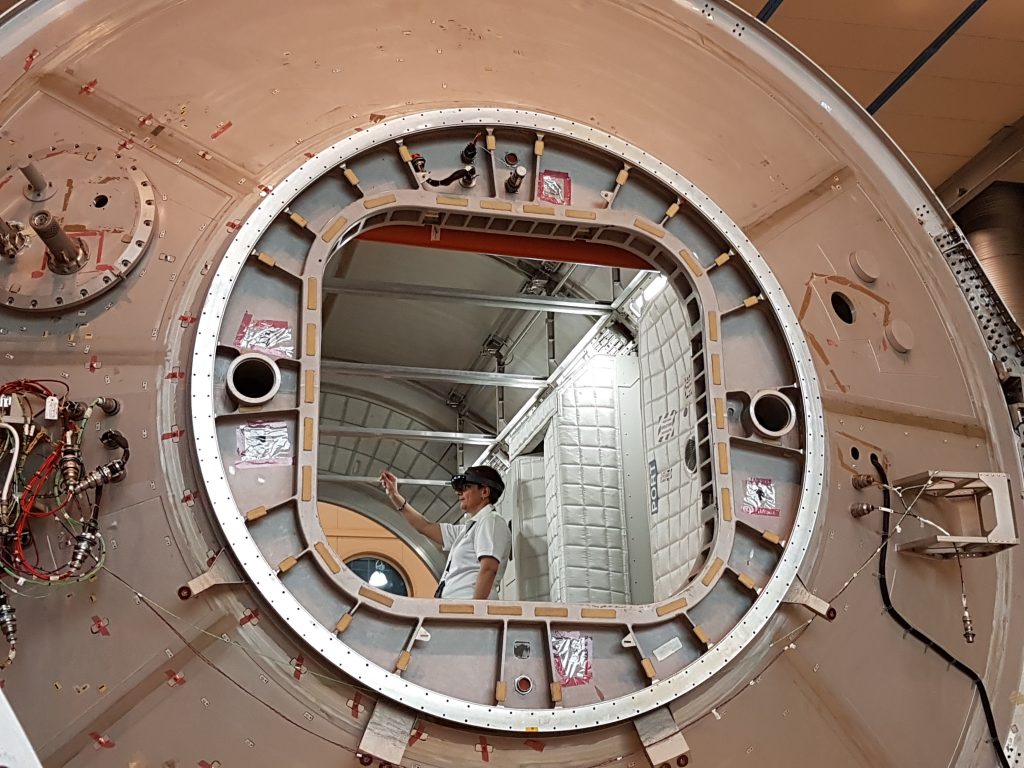
A trans-European team of researchers is transforming industrial learning and training with the use of innovative Augmented Reality and Wearable Technology (AR/WT).
Wearable Experience for Knowledge Intensive Training (WEKIT) is a 2.7 million EURO research and innovation project funded by Horizon 2020, to develop and test a novel way of training using smart wearable technology within three years.
Dr Fridolin Wild, Senior Research Fellow at Oxford Brookes University and Principal Investigator and Scientific Director of the WEKIT Project said: “In the modern world, there tends to be a concern that technology is developing so rapidly that it will replace humans in the workplace.”
“WEKIT demonstrates that cutting-edge technology can actually help humans become better at work, quicker, less error-prone, more engaged and healthier.”
Using AR, WEKIT effectively brings textbooks to life using digital visual and audial information that overlay on the physical environment, for example in the form of animations. The WEKIT.one soft- and hardware system shows the trainee what to do through the eyes of the expert, allowing the trainee to learn by experience rather than simply reading about it or watching a video tutorial. It also allows an expert to create instructions easily – by capturing performance using WT.
Dr Wild continued: “Using augmented reality as a medium for learning and work is a powerful tool, particularly in high-skill settings which require the teaching or re-teaching, of complex manufacturing and engineering tasks after ‘Industry 4.0’.”
“Crucially, it also has the potential to have a positive impact on the time and costs of training large numbers of people.”
The new WEKIT.one AR system, involving the Hololens and other wearable devices, was recently put into action for the first time when it was tested with 142 experts and trainees at three separate organisations; in Tromsø, halfway to the North Pole in the Arctic circle, and in Turin and Genoa, Italy.
Throughout the trials, specially developed applications for both the experts and novices were used and feedback was collected to assess the suitability and acceptance of the system in three distinct scenarios:
- Medics and engineers at the Arctic town of Tromsø performed equipment checks on the aircraft used as emergency responders in the region. More than 50 students donned the Hololens and used the WEKIT training application to carry out the checks. The system walked them through the air ambulance with the aid of holograms and audio instructions and gave them real-time feedback on their progress.
- At ALTEC (a service provider for the Italian Space Agency) WEKIT tested a procedure for setting up stowage racks for use by astronauts on the International Space Station. Trainees were tracked as they installed the equipment, monitoring their efficiency on every step as well as their heart-rate variability.
- With the help of radiologists in Genoa and EBIT, a medical software company, a number of medical students were trained to assess the blood flow in the carotid artery on an unfamiliar ultrasound machine. This tricky procedure involves following instructions (laid out in 3D) whilst maintaining control of both an ultrasound probe and a patient (in our case: an actor). A holographic tutor delivers the recorded think-aloud explanation of the expert, while instructional holograms, floating videos and to-be snapshots guide step by step through the procedure. Tested by medical and engineering students, this trial provided in-depth feedback on the subtleties of using AR for complicated, interactive procedures.
The trainees and experts involved in the trial evaluated specific features of the prototype and the training approach, technology acceptance, system usability, user satisfaction of training with AR glasses and human-computer interface, and simulation sickness.
More information about WEKIT: http://www.wekit.eu
ENDS
For more information, please contact: Natalie Gidley, Communications Officer (Media Relations) at Oxford Brookes University on 01865 484452 or ngidley@brookes.ac.uk.
Notes to Editors
- Images and video footage taken during the WEKIT trails are available. Please contact the Oxford Brookes University press office.
- The scientific coordination of WEKIT is at Oxford Brookes University in the UK, the administrative coordination with the Italian IT company GFT. WEKIT brings together four further academic partners including Ravensbourne (UK), University of Tromsø (Norway), Open University (The Netherlands), and RWTH (Germany).
- The research centres at Oxford Brookes University (UK), Open University of the Netherlands (NL), VTT (Finland), and the high-tech SME MyndPlay (UK) are leading the development of the key components of the platform.
- Three industry partners – Norway-based Lufttransport as well as EBIT and ALTEC from Italy – are leading evaluation cases to test the WEKIT training methodology and technological platform in real practical settings.
- Set in a historic student city, Oxford Brookes is one of the UK’s leading universities and enjoys an international reputation for teaching excellence and innovation as well as strong links with business and industry. More information is available on the Oxford Brookes website at www.brookes.ac.uk